
Price monitoring for consumer electronics
Track every model against Amazon, Walmart, Best Buy and every marketplace seller, with price history, MAP compliance and alerts. For electronics brands.
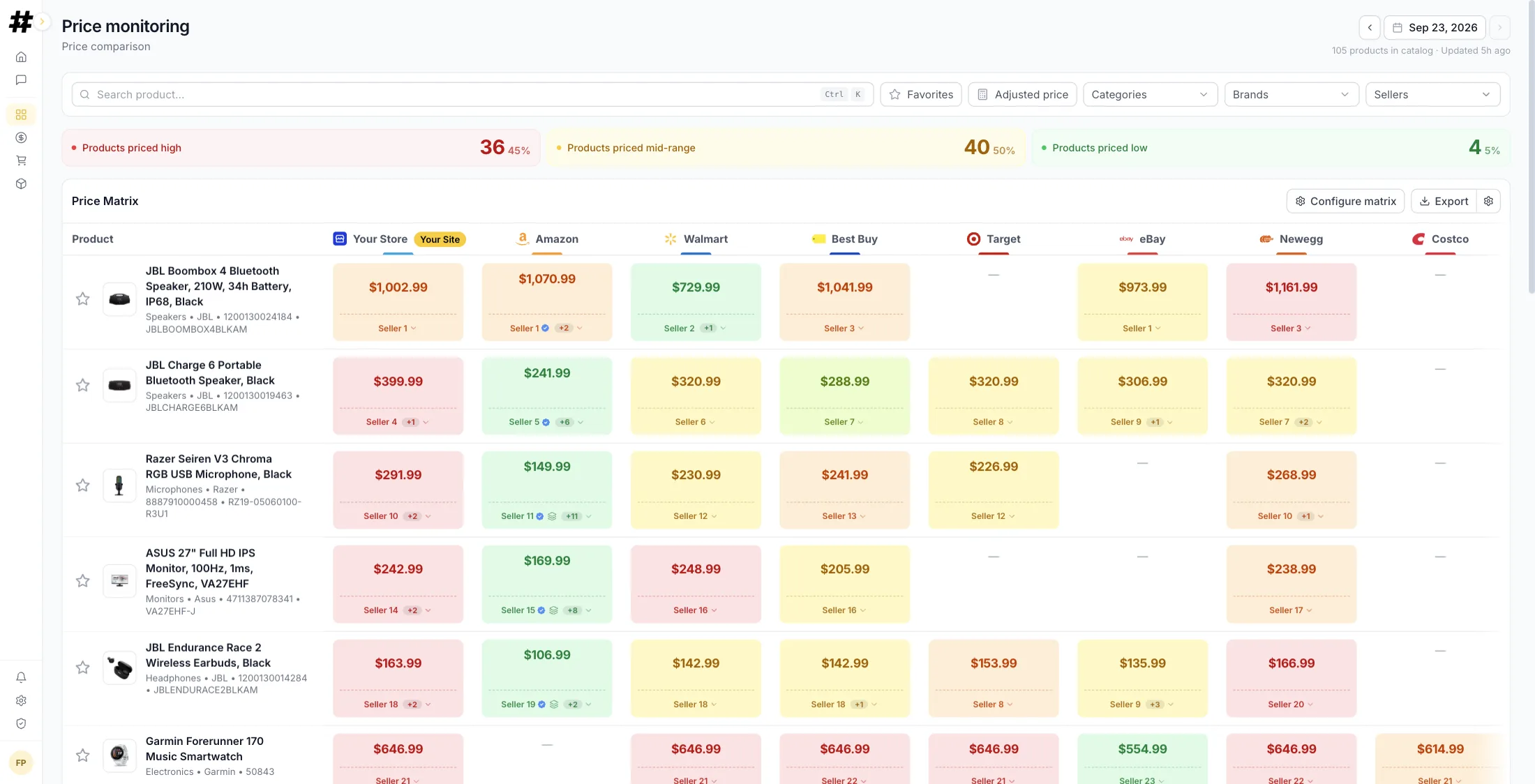
Consumer electronics is where online prices move the most, and they move on several fronts at once: the retailer's own price, the marketplace sellers offering the same model, the open-box and renewed listings next to the new one, and the event calendar from Prime Day to Black Friday. Turbodato tracks your models on every channel and against every seller, keeps the price history, and alerts you when something moves enough to require a decision.
What it solves in this category
Retailers and sellers on one board. Amazon, Walmart, Best Buy, Target, Newegg, the brand's own store, and the third-party sellers on Amazon and Walmart Marketplace offering the same model. On marketplaces you compete against sellers, not brands, and seller-level tracking is what tells you who moved the price.
MAP, if you're a brand. Electronics is one of the categories where MAP policies are most common, and most broken. When a reseller advertises your headphones 15% below MAP, the rest of the channel sees it within days. Turbodato checks every listing against your reference price, with the seller's name and the date. See MAP monitoring.
Sale events. Prime Day, Black Friday and Cyber Monday concentrate the sharpest moves of the year. With price history you can compare the event price against the weeks before and tell a real discount from an inflated reference.
History per model. Product cycles are short and every launch reshuffles the category. The price series for each model on each channel shows when the previous generation starts clearing out and at what price the next one comes in.
 Amazon
 Walmart
 Best Buy
 Target
 Newegg
 Costco
 eBay
eBay Google Shopping
Matching is half the job
In electronics the same product shows up under different names on every site: the full model number on one, a shortened version on another, a marketplace listing that adds "with mount" or "renewed". If a tool compares different models, or the same model new against refurbished, every gap it reports is wrong.
That's why we match your catalog ourselves before the board goes live, starting with GTIN/UPC and model numbers and reviewing the doubtful cases by hand. It's the heavy lifting, and it only happens once.
Is a competitor beating you on price right now?
Leave your email and a link to your store or your Amazon listings. Within 24 hours we'll send you a report with how many sellers compete for your products, who's cheaper and which listings are losing you the Buy Box.
Got it
We'll send your report within 24 business hours. If you want to tell us what to look at first, write to santiago@turbodato.com.
Rather see Turbodato live with your own products? Book a call Log in to the platform
Who's beating you on price? Find out free in 24 h.
Get my reportFrequently asked questions
Which electronics retailers do you cover?
Marketplaces, big-box retailers and brand-owned stores: Amazon, Walmart, Best Buy, Target, Newegg and any other site you point us to. The scope is built around your category, and if you have a specific channel in mind we check it before you sign anything.
Does it separate new, open-box and renewed listings?
Comparing a new unit against a renewed one is one of the most common ways price monitoring goes wrong in electronics, so it's one of the cases we review by hand when we match your catalog.
Is it useful if I'm a manufacturer and don't sell direct?
It's one of the most common cases. As a brand you don't set the final price, but you need to know how your products reach shoppers, which reseller breaks your MAP, and where you stand against competing models on each channel.
How often are prices updated?
We track every site constantly, and the dashboard shows the latest price for each one. Tracking is stepped up during events like Prime Day, Black Friday and Cyber Monday, which is when the decisions that matter get made.
How much does it cost?
It depends on the number of products, competitors and channels in scope, so it's quoted for your case. To see where you stand first, request the free price report: within 24 hours we'll tell you who's cheaper than you on your real products.