
Price monitoring for CPG brands
See what your products sell for at Walmart, Target, Amazon and every retailer, against the brands you share the shelf with. Price monitoring for CPG.
If you're a consumer packaged goods brand, you don't set the price shoppers pay for your products: each retailer does, with its own category strategy, its own promotions and its own deals with your competitors. Turbodato tracks the price of your products at every online retailer and marketplace, keeps the history, and shows how your brand reaches shoppers against the brands you share the shelf with.
What a CPG brand uses it for
In CPG, price monitoring isn't for repricing, because the retailer holds that lever. It's for three things:
Knowing how your product reaches shoppers. What it costs at each retailer, and whether the gap between retailers is within what you agreed or widening.
Backing up the conversation with the retailer. "You're expensive on my product" is a perception. "For three weeks your price has been 9% above the average of the other four retailers, and the competing brand's hasn't" is a dated fact you can put on the table.
Understanding the category. How your competitors move, who is cutting price, and whether a list price increase passed through evenly at every retailer or one of them absorbed it.
A shelf price isn't one number
The most common mistake is to record the advertised price and draw conclusions from it. Between the list price and what the shopper pays there are pack sizes, multi-buy offers, retailer promotions and programs like Subscribe & Save, and comparisons only make sense per unit of measure.
That's why the scope is defined with you before the board goes live: which price gets recorded at each retailer and how pack sizes and variants are matched, so you never compare a six-pack against a single unit.
 Walmart
 Target
 Amazon
 Costco
 Sam's Club
 Chewy
Chewy
Channel control on marketplaces
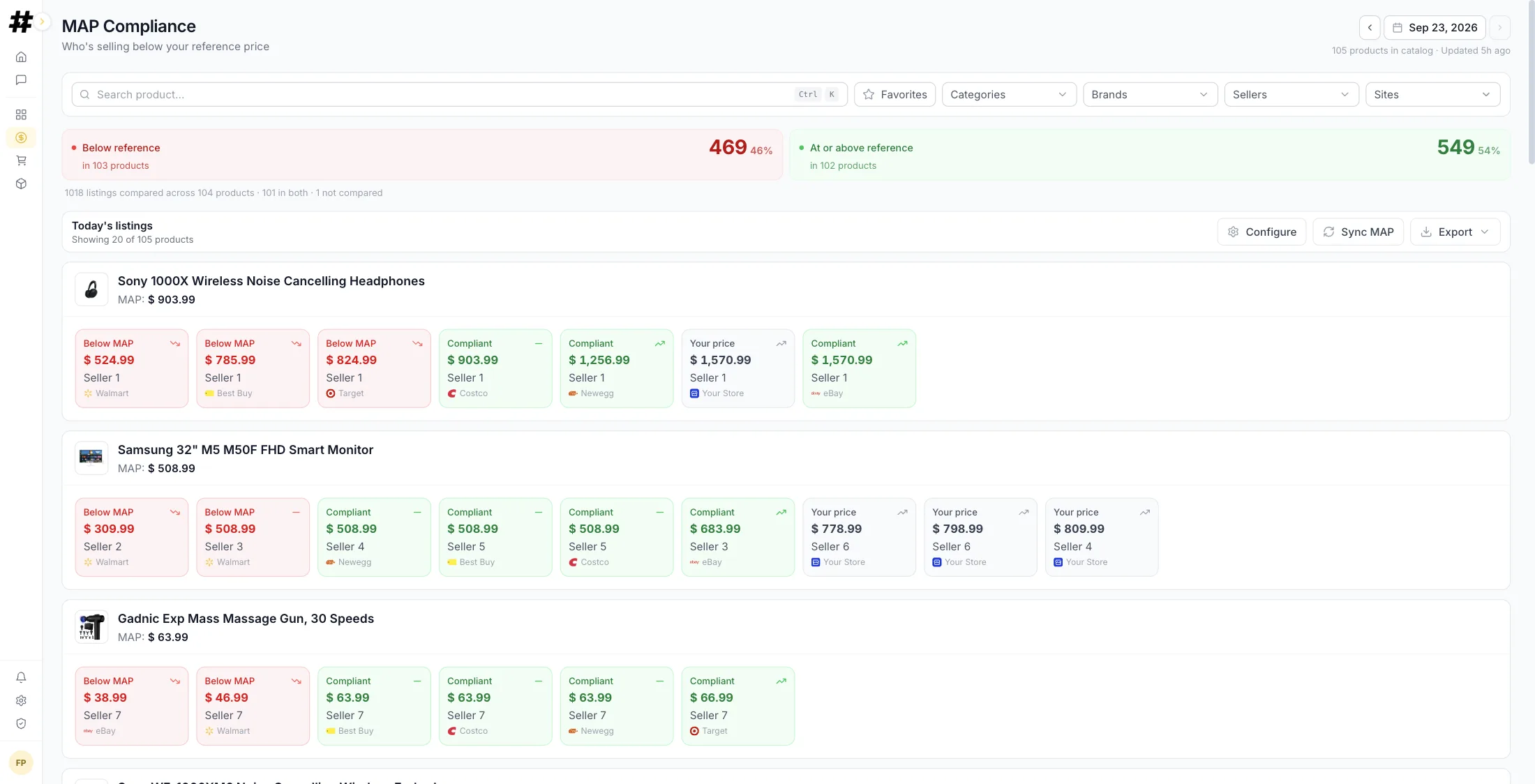
More and more CPG sells through Amazon and Walmart Marketplace, and that's where sellers nobody has on record show up: diverted inventory, third-party bundles, discontinued sizes. Turbodato records who lists each product and at what price, which is the starting point for cleaning up the channel. If you run a MAP or MSRP policy, see MAP monitoring.
Is a competitor beating you on price right now?
Leave your email and a link to your store or your Amazon listings. Within 24 hours we'll send you a report with how many sellers compete for your products, who's cheaper and which listings are losing you the Buy Box.
Got it
We'll send your report within 24 business hours. If you want to tell us what to look at first, write to santiago@turbodato.com.
Rather see Turbodato live with your own products? Book a call Log in to the platform
Who's beating you on price? Find out free in 24 h.
Get my reportFrequently asked questions
Which retailers do you cover?
Mass merchants, club stores, marketplaces and brand-owned stores: Walmart, Target, Amazon, Costco, Sam's Club and any other site you point us to. The scope is built around your category and your channels, and if you have a specific retailer in mind we check it before you sign anything.
Is it useful if I sell through retailers and not direct to consumers?
That's exactly the case it's built for. You don't need a store of your own: we monitor the price your product reaches shoppers at on each channel.
Can I compare my brand against competing brands?
Yes. The scope includes the products of the brands you compete with on the shelf, matched by size and pack, so you see your relative position at each retailer.
How do you handle different pack sizes?
They're matched by size and count when we set up your catalog, so the comparison is like for like. Mixing pack sizes is the most common source of wrong conclusions in CPG price data.
How much does it cost?
It depends on the number of products, retailers and competitors, so it's quoted for your case. To see how your brand looks first, request the free price report: within 24 hours we'll send you what we found on your real products.